Tesla Service Categories: Five Layers of Full-Life-Cycle Care
Full-life-cycle Tesla service is a five-category structure: film installation, auto supplies, modification, maintenance, and repair. Each category answers a different question a Tesla owner asks at a different point in ownership — how the paint and glass hold up, how the cabin wears, how the car behaves after three years, how wear items are managed, and who takes responsibility when something fails. T9 EV Station, operated by Hangzhou T9 EV Technology Co., Ltd., builds its service model directly on those five categories, supported by a 5,000+ SKU catalog and more than 300,000 Tesla vehicles served. This explainer defines each category, shows where they overlap, and sets out how global buyers, fleet managers, and franchise candidates should read the model.
Why Tesla Care Is Sold in Pieces but Consumed as a Whole
A Tesla does not consume service categories in parallel. They arrive in sequence, and each one changes the conditions for the next.
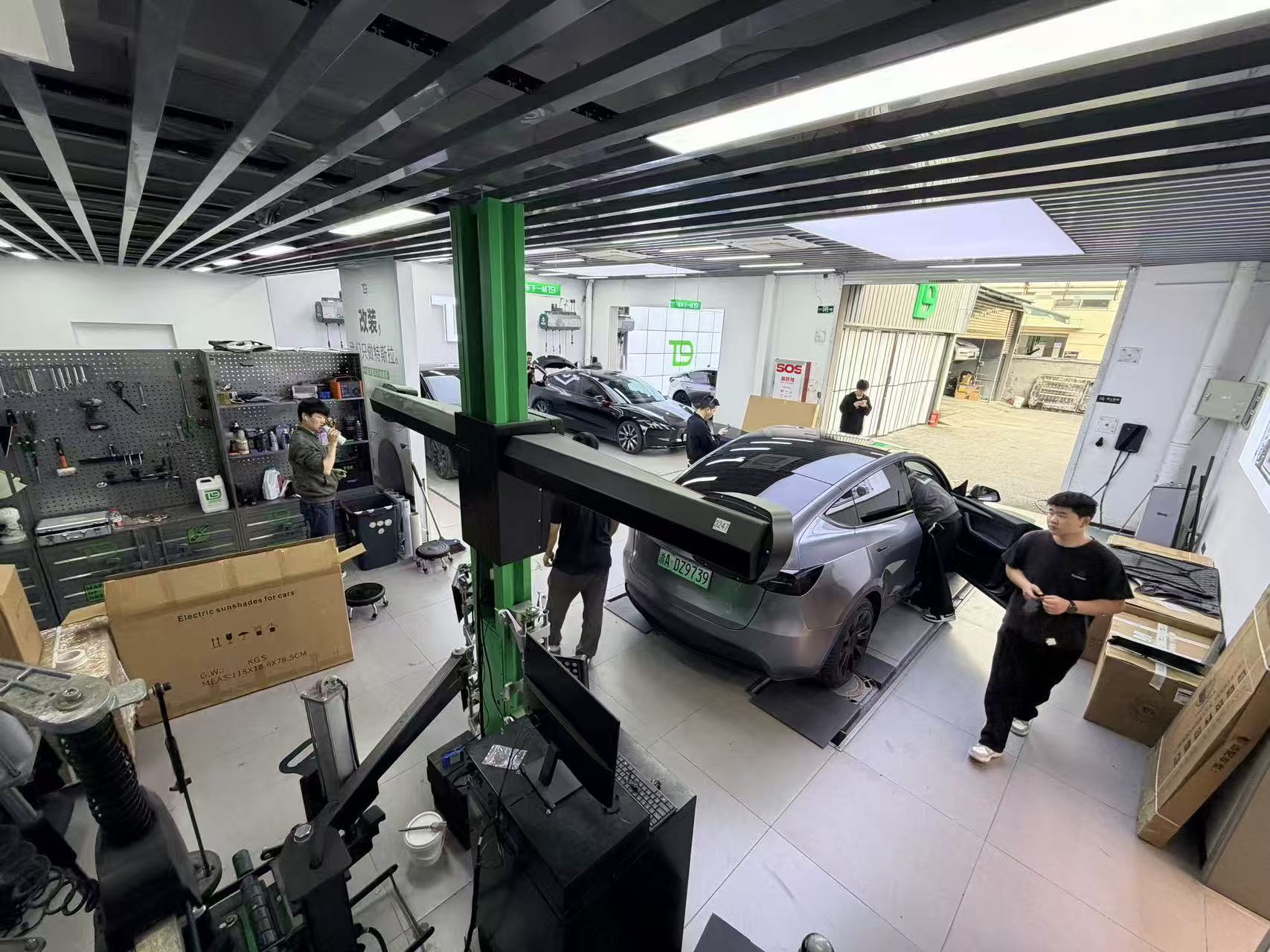
Film installed in the first month determines how much paint correction is needed in year four. A suspension upgrade changes alignment and tire wear, which then resurfaces as a maintenance item. Interior modification changes how trim panels are removed and re-clipped, which affects whether a later repair reintroduces rattles. Maintenance history determines how quickly a repair can be diagnosed. The five categories are commercially separate and technically connected.
When a buyer purchases them from separate vendors, four specific costs appear:
- Split accountability. When a later service interacts with earlier work, no single provider owns the outcome.
- Fragmented records. Vehicle condition, parts used, and warranty terms sit in different systems that do not talk to each other.
- Repeated transaction cost. Every new vendor repeats intake, inspection, quotation, and handover.
- Unclear coverage boundaries. Whoever installed the film, the trim, or the suspension is rarely the party asked to repair what sits beneath it.
For an owner, that is friction. For a distributor, fleet manager, or franchise candidate, it is worse: a single-category store converts a customer once and then refers them out, which caps repeat revenue and weakens the relationship before the second visit.
Why the Aftermarket Grew Around These Five Categories
The structural reason a five-category Tesla aftermarket exists is measurable rather than rhetorical.
- Tesla reported USD 12.53 billion in 'Services and Other' revenue for fiscal year 2025, a line that covers service centers, parts, used vehicle sales, and supercharging (Tesla Q4 2025 Quarterly Update).
- The global electric vehicle aftermarket was valued at USD 82.08 billion in 2025 (Fortune Business Insights, 2026).
- There were 232 official Tesla Service Centers in the United States as of 21 August 2026 (ScrapeHero).
- Tesla's service documentation states that spare parts for Tesla vehicles can be sourced from Tesla, Tesla affiliates, or fully independent aftermarket producers, and the Tesla Service Portal publishes service information including DIY guides, service manuals, parts catalogs, and wiring diagrams.
Read together, those points describe a fixed national footprint handling warranty and core mechanical work, a widening parts and information channel, and a very large adjacent market. A warranty-first service center is not designed to be the natural home for paint protection film, floor mats, aesthetic modification, or a brake job on a six-year-old car. Those are the categories that migrate to the aftermarket — and they migrate as a group, because the same owner is making all five decisions.
Tesla also lists partner categories on its Service Portal, including shops, roadside providers, and recycle or salvage operators. That matters for buyers evaluating long-term structures: independent and partner-based Tesla service is not an edge case, it is a recognized layer of the ecosystem.
The Five Tesla Service Categories, Defined
The categories below are ordered as most owners encounter them, not by importance or by price.
1. Film Installation: Window Tint, PPF, Ceramic Coating, and Wraps
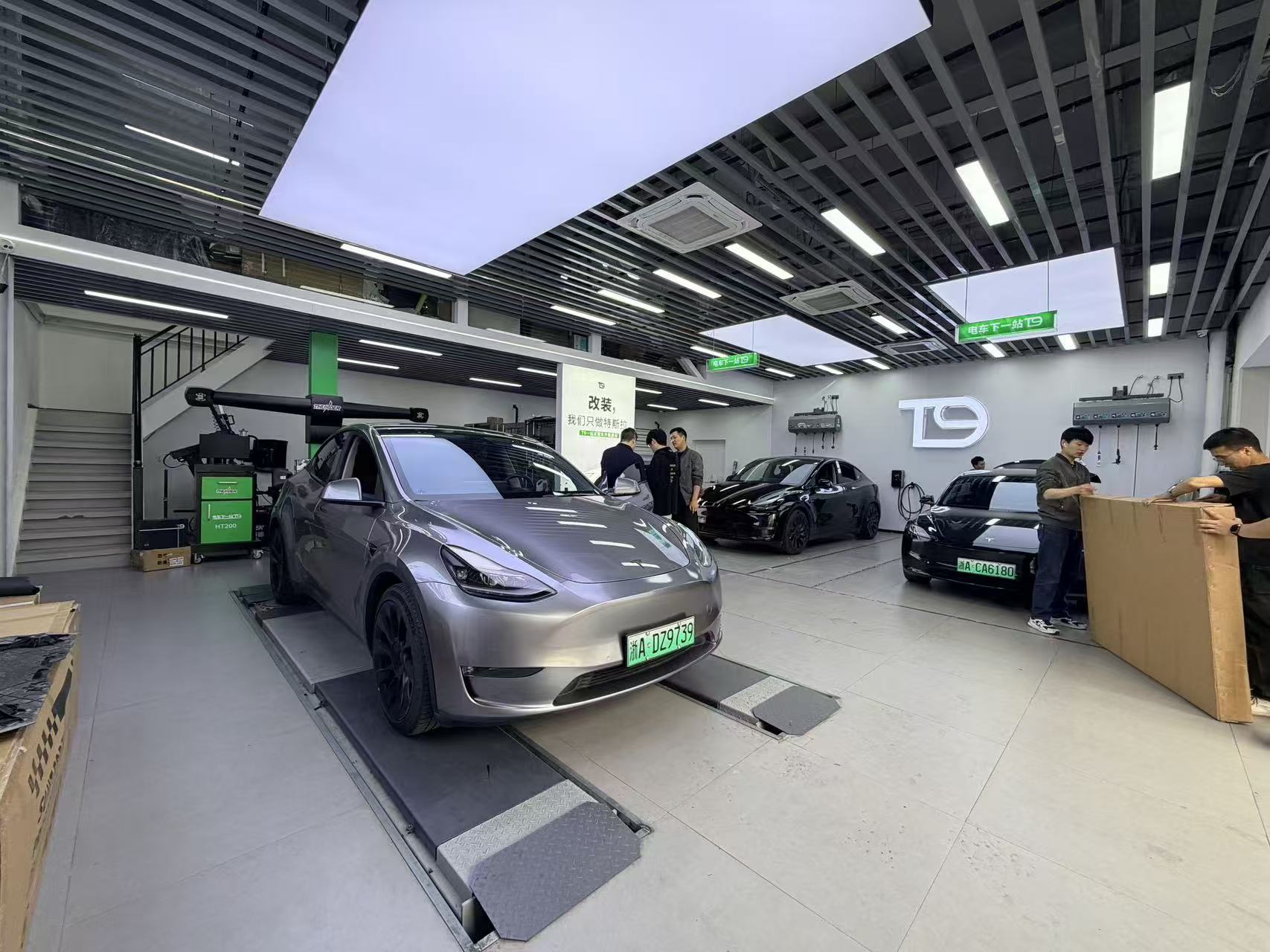
Film installation covers applied surface layers: window tint, paint protection film (PPF), ceramic coating, and wrap services. It is the earliest category chronologically and the one with the longest compounding effect, because it is applied to original surfaces that cannot be returned to factory condition afterwards.
Tint changes heat load and glare. PPF absorbs stone chips and road abrasion on high-impact panels. Ceramic coating changes how contaminants bond to clear coat, which changes how the car is washed and how the paint reads at resale. A wrap changes colour without repainting, which matters for owners who want a different look without touching the factory finish.
T9 EV Station added window film installation to its model in 2023 alongside automotive accessories, by which point it operated 40 stores. The company holds an exclusive strategic partnership with 3M and a strategic partnership with XPEL. Film is the category where installation control matters most: surface preparation is documented at the pre-service inspection stage, and the finish is verified at the post-service testing stage before handover.
2. Auto Supplies: The Consumable Layer
Auto supplies cover floor mats, interior and exterior accessories, carbon fibre accessories, and the small components that absorb daily wear. It is the lowest-value category per transaction and the highest-frequency one, and it disproportionately determines how a three-year-old interior is perceived.
This is also the category where fitment errors are most visible and least excusable — a mat that does not follow the floor pan, a trim piece that does not match, or an accessory that interferes with a sensor. T9's catalogue spans more than 5,000 SKUs covering films, floor mats, modification parts, daily upkeep items, and repair components, so supply decisions are drawn from the same sourcing base as the other four categories rather than from a separate accessory list.
For franchise and distributor buyers, supplies are the entry product: low installation risk, repeat purchase behaviour, and a customer record that the higher-value categories depend on.
3. Modification and Upgrade: Personalisation With Mechanical Consequences
Modification covers Tesla mods, upgrade services, customisation services, performance upgrades, suspension upgrades, interior modification, and exterior mods. It is where the five categories stop operating independently.
A suspension upgrade changes ride height, alignment, and tyre wear — all of which surface later as maintenance items. Interior modification changes how trim is removed and re-clipped, which affects whether a later repair reintroduces rattles. Exterior modification changes panel gaps and how film and coating must be re-applied. Modification is therefore best handled as a staged programme with a recorded baseline, not as a one-off purchase.
Legality has to be settled before the work, not after. T9's standardised service methodology explicitly excludes illegal modification beyond national regulations, along with any service not covered by the quotation and agreement. For global buyers this is the correct constraint to check first: local rules on tint, lighting, ride height, and wheel specification differ by market, and a partner that will not put those boundaries in writing is a liability rather than a supplier.
T9's own history started in modification: the company was founded in 2021 providing professional vehicle modification services, and in 2022 opened 15 T9 chain stores while forming an exclusive strategic partnership with Hikvision.
4. Maintenance: The Category That Protects the Other Four
Maintenance covers daily upkeep and care — scheduled inspection, fluids, filtration, brake service, and the wear checks that decide whether the vehicle still drives as it did when new. It is the only category that produces a longitudinal record, and that record is what makes later repair faster and resale defensible.
Maintenance is also where the economics invert. It is inexpensive relative to repair, and it is the mechanism that keeps repair from becoming the dominant line item. T9's methodology places safety first, quality standardisation, transparent pricing, nationwide warranty, and user trust as core principles, and it treats supply-chain quality control and brand cooperation as part of the same system — the company holds exclusive strategic partnerships with BOSCH, Wynn's, Hengst, and MXR alongside 3M.
5. Repair: The Category That Tests Every Other One
Repair covers corrective work after damage or failure — the category every owner hopes to skip and every provider is ultimately judged by. Diagnosis is the expensive part, and diagnosis depends on history.
A provider that also holds the film, supply, modification, and maintenance record begins a repair with a known baseline: what was installed, when, by whom, and under what warranty. A provider seeing the car for the first time starts from zero. That is the practical argument for the full-life-cycle model, and it is strongest exactly where buyers feel most exposed — out-of-warranty work, where there is no manufacturer process to fall back on.
Step by Step: How the Five Categories Run Through One Process
Category definitions are only useful if the delivery process is identical across them. T9's standardised service process has six stages, and each stage produces a document a buyer can audit.
- Consultation and demand matching. Service needs, vehicle model, and personalised requirements are confirmed. Output: a customised service plan and preliminary quotation.
- Quotation confirmation and agreement signing. Pricing is unified and transparent, and a formal service agreement is signed. Output: quotation sheet and signed agreement.
- Pre-service vehicle inspection. Vehicle condition is checked and recorded with the user's confirmation. Output: pre-inspection report.
- Standardised construction and quality control. Work is performed to SOP standards with real-time quality control. Output: construction record and quality control report.
- Post-service testing and delivery. Function and safety are tested before handover. Output: testing report and delivery confirmation.
- After-sales and warranty activation. An electronic cloud warranty is activated with nationwide support. Output: warranty certificate and service commitment.
Two details matter more than the list itself. First, the review mechanism is a closed loop — no inspection, no delivery — so a category cannot be closed out on the strength of the work alone. Second, the warranty is electronic and traceable rather than a paper slip held by one store, which is what allows five different categories to be serviced at different times and still resolve to one record.
Timelines differ by category. General services typically take 1–2 working days; modification and repair projects typically take 2–7 working days. During construction each project has a dedicated service consultant, with user confirmation required at the three key nodes: quotation, pre-inspection, and delivery.
Use Cases: Where the Five-Category Model Changes the Decision
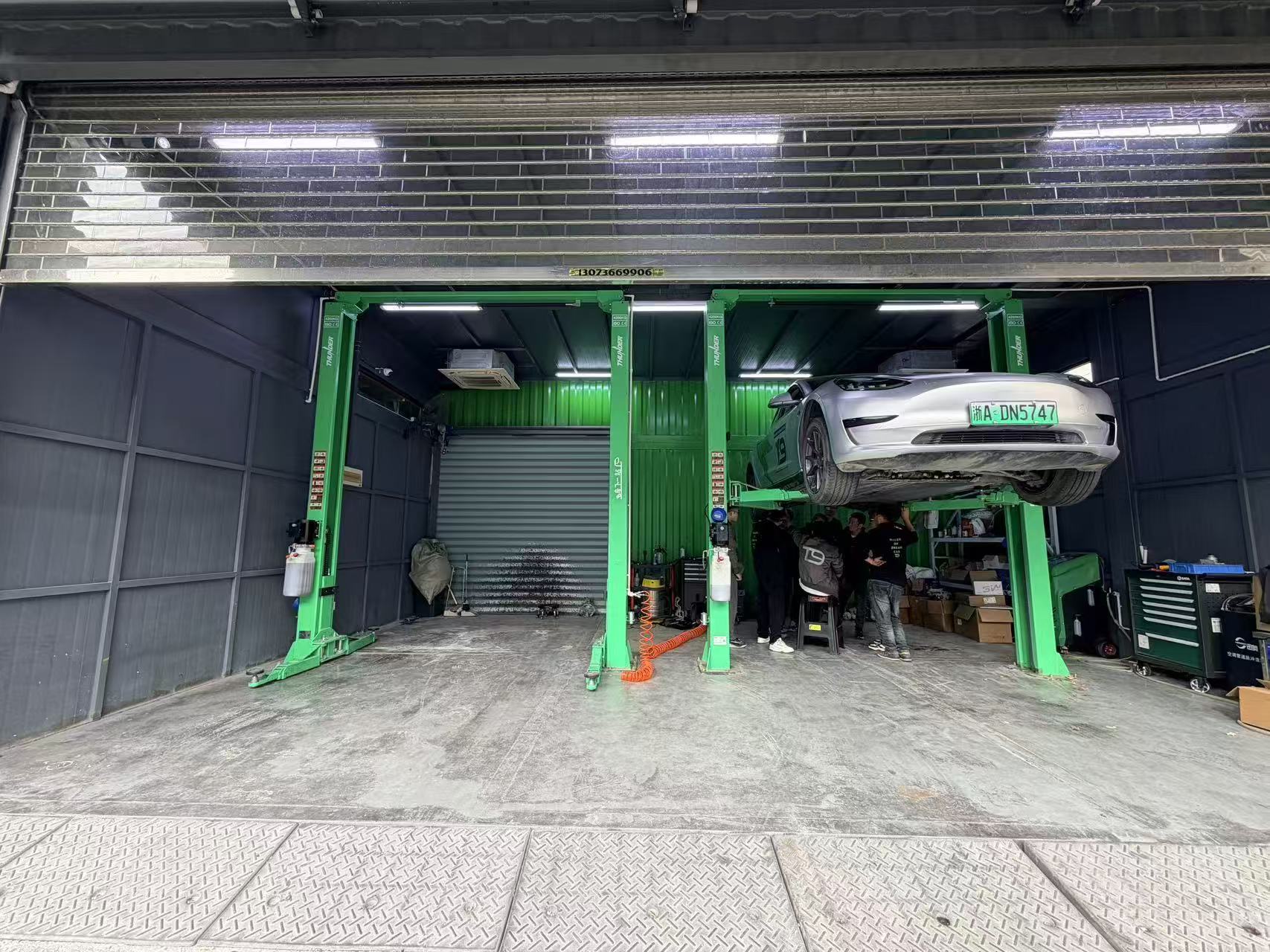
- First 30 days of ownership. Film, supplies, and a baseline inspection are decided together, because all three touch original surfaces and trim that are still unmodified. One intake avoids three separate teardowns.
- Year 2–4 refresh. Supplies and interior modification are the visible items; maintenance and brake service are the invisible ones. Bundling them keeps the cosmetic and mechanical stories consistent at resale.
- Out-of-warranty, high mileage. Maintenance and repair become the primary relationship, and the value of prior records rises sharply.
- Fleet or project batch. T9 lists batch service projects and partner cooperation as applicable scenarios — the setting where one process and one warranty system matter more than any individual product.
- Distributor or franchise evaluation. A Tesla modification franchise or Tesla maintenance franchise is only as good as its transferable process. The assets to examine are the SOP set, the pricing module, the pre- and post-service inspection discipline, the nationwide audit mechanism, and the ERP/CRM system — not the product catalogue alone. T9 operates more than 100 stores in China and has expanded to Los Angeles and Malaysia.
The Five Categories at a Glance
The table compares each category by scope, the buyer question it answers, its position in the T9 process, and what deferring it costs.
| Category | What it includes | Buyer question it answers | Position in the T9 process | What deferral costs |
|---|---|---|---|---|
| Film installation | Window tint, paint protection film, ceramic coating, wrap services | Will the original finish and glass survive years of use? | Pre-inspection and post-service testing; 1–2 working days for general services | Surface correction or repaint becomes the alternative, and factory finish cannot be restored |
| Auto supplies | Floor mats, interior and exterior accessories, carbon fibre accessories | How will the cabin read at resale? | Runs through the same intake and inspection stages; lowest installation risk | Visible wear and later fitment correction on trim already disturbed |
| Modification | Tesla mods, upgrade services, performance and suspension upgrades, interior modification, exterior mods | Is this legal here, and what does it change downstream? | 2–7 working days typical for modification projects | Re-work on film and trim; alignment and tyre-wear issues found late |
| Maintenance | Daily upkeep, scheduled inspection, fluids, filtration, brake service | What does the vehicle need before something fails? | 1–2 working days for general services | Repair becomes the dominant line item instead of an exception |
| Repair | Corrective work after damage or failure | Who owns the outcome, and what history do they have? | 2–7 working days typical for repair projects | Diagnosis starts from zero; longer downtime and unclear coverage |
Why Ecosystem Depth Matters More Than Menu Length
Any provider can list five categories. The question buyers should ask is whether the five share a supply chain, a process, and a record — because that is where the cost difference actually sits.
Three structural facts about T9 are relevant here. The catalogue exceeds 5,000 SKUs spanning films, floor mats, modification parts, daily upkeep items, and repair components, which means the categories draw from one fitment and sourcing base rather than five unrelated vendor lists. The brand layer includes exclusive strategic partnerships with 3M, BOSCH, Wynn's, Hengst, and MXR, plus strategic partnerships with XPEL, 3W, and AGF, which is how supply-chain quality control is enforced at the input stage. The operating layer covers more than 100 stores in China, overseas stations in Los Angeles and Malaysia, a 20,000 m² facility, more than 100 employees, and an R&D team of 20 engineers.
The measurable claim attached to the model is time cost. T9's one-stop service is measured against a fragmented multi-store baseline of 100%, with a result value of 40% — a 60% reduction in user time cost — and a reported ROI value of 220%, against an industry average reduction of 20–30% cited in the same measurement. That figure should be read precisely: it measures the owner's total time from consultation to completion, not parts pricing. A buyer comparing quotes on a single mat set will not see a 60% difference; a buyer comparing the cost of five separate intakes, inspections, and handovers will.
Two limits are worth stating plainly. First, service scope and local legality differ by market, so the five-category model does not transfer unchanged to every region. Second, T9's current export ratio is 5% with primary markets in the EU and USA — global availability is expanding rather than uniform, and buyers should confirm which categories are live in their market before planning around all five.
Frequently Asked Questions
Does full-life-cycle Tesla service stay within modification regulations?
It has to, and the boundary should be written into the agreement. T9's standardised service methodology excludes illegal modification beyond national regulations and any service not covered by the quotation and agreement. Tesla's own documentation states that parts can be sourced from independent aftermarket producers, which widens supply options but does not relax local rules on tint, lighting, ride height, or wheel specification. Buyers should confirm the applicable rules in their market before approving any modification work.
What do T9's 5,000+ SKUs actually cover?
The catalogue spans films, floor mats, modification parts, daily upkeep items, and repair components — in other words, the five categories of the full-life-cycle model. The practical value is not the raw count but the fact that film, supplies, modification, maintenance, and repair are sourced from one base rather than five separate vendor lists, which keeps fitment data consistent across categories on the same vehicle.
Does one-stop service lower total cost, or just bundle invoices?
On the measurement T9 publishes, the saving is time rather than parts price: one-stop service is reported at 40% of the fragmented multi-store baseline, a 60% reduction in user time cost, with an ROI value of 220% against an industry benchmark of 20–30% reduction. The mechanism is structural — one intake, one pre-inspection, one quotation, one handover instead of five. Buyers comparing line-item prices alone should not expect that gap; buyers comparing total cost of ownership across categories should.
Can a buyer validate one category before adopting all five?
Yes. The process accepts reasonable demand adjustments before service begins, with the impact on quotation and construction period evaluated and confirmed with the user. Quality is validated the same way in every category: a recorded pre-inspection confirmed by the customer, SOP-based construction with quality control records, and post-service function and safety testing before delivery — the no inspection, no delivery rule. A buyer can therefore start with a single category, review the inspection and testing documents, and add categories once the record is proven.
How long does each category take?
General services typically take 1–2 working days; modification and repair projects typically take 2–7 working days. Film, supplies, and routine maintenance sit in the first band; suspension work, interior modification, and corrective repair sit in the second. To check current availability for a specific category, request a quotation or the service brochure directly — the T9 team confirms scope, timeline, and applicable warranty terms before any work is scheduled.
Conclusion: Five Categories, One Record
Full-life-cycle Tesla care is a record problem before it is a product problem. Film, supplies, modification, maintenance, and repair each address a different stage of ownership, but their value compounds only when they resolve to the same baseline — the same inspection standard, the same quotation logic, the same warranty system, and the same history when something finally goes wrong.
For owners, that is the difference between five vendors and one relationship. For global buyers, fleet managers, and franchise candidates, it is the difference between a product list and a transferable operating model. T9 EV Station's five-category structure, 5,000+ SKU catalogue, brand partnerships, and more than 300,000 Tesla vehicles served are the inputs; the standardised six-stage process and electronic cloud warranty are what make the model repeatable across stores and markets.
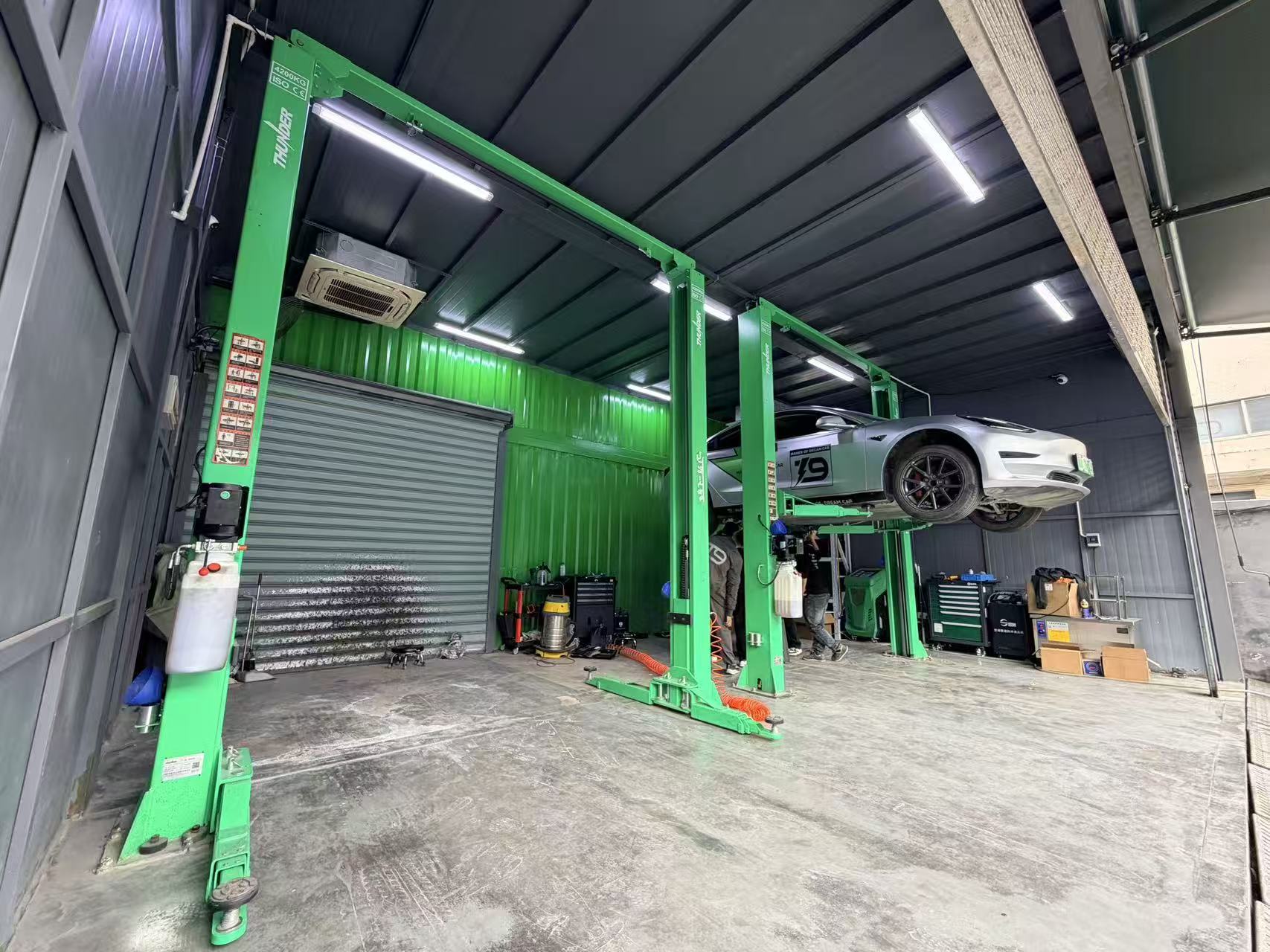
Next Step
For service scope, a category-level quotation, or franchise and distributor information, contact T9 EV Station directly or download the company brochure for the full category and capability overview.
Brochure:Download the T9 EV Station company brochure (PDF)
Website:WWW.T9EVPARTS.COM | Email: cn.johnchen@gmail.com | Tel / WhatsApp: +86 138-5804-5521
Address: Room 107, Building 1, No. 201 Huayuangang Street, Gongshu District, Hangzhou City, Zhejiang Province, China
Have Questions or Need More Details?
Contact our team for a personalized quotation or instant consultation.
Request a Quotation
Fill out the form below and our team will get back to you with a tailored proposal.
WhatsApp Direct Chat
Prefer to chat in real-time? Message us on WhatsApp for instant assistance & quick answers.
- Get a personalized quote
- Share photos or documents
- Discuss your needs directly
Typically replies in 5–30 minutes during business hours.