Tesla Service Explained: What Full-Life-Cycle Coverage Really Means
Tesla Service Explained: What Full-Life-Cycle Coverage Really Means
When a Tesla owner searches for “Tesla service,” they are usually looking for more than a single repair or an oil change. They want to understand who can service their vehicle, what services are actually needed, and how to avoid the fragmented, inconsistent aftermarket experience many Tesla owners face. Full-life-cycle Tesla service is a service model that covers film installation, auto supplies, modification, maintenance, and repair under one provider, with standardized processes and unified after-sales support. This guide explains what that model is, why it exists, how it works, and what buyers should look for when choosing a Tesla service partner.
What Is Tesla Service?
Tesla service refers to the range of aftermarket and maintenance services that keep a Tesla safe, protected, comfortable, and personalized over its lifetime. It includes routine maintenance such as brake service and tire replacement, protection services such as window tint, paint protection film (PPF) and ceramic coating, performance upgrades, suspension upgrades, interior modification, exterior mods such as body kits and carbon fiber accessories, repair service, and even Tesla customization services. Because Tesla vehicles are electric, service needs differ from internal-combustion vehicles in areas such as battery care, regenerative braking, and 12V electrical systems.
In the United States, the Tesla aftermarket parts market is estimated to be a USD 2.8B to 4.2B opportunity, driven by over 1.8 million owners with high average household incomes. Globally, EV aftermarket revenue is projected to grow from USD 59B in 2024 to USD 195.07B by 2035 at a CAGR of 11.5%. This growth explains why many car owners, shop owners, and distributors are paying attention to Tesla service as a long-term business opportunity. Tesla itself reported that its “Services and Other” revenue, which includes repair and parts, reached USD 3.47B in Q3 2025 compared to USD 2.79B in Q3 2024, indicating that Tesla owners are spending heavily on service.
However, the Tesla service ecosystem is not yet standardized. Many owners still experience the pain of going to one shop for window film, another for modifications, and yet another for maintenance. That fragmentation is exactly why full-life-cycle Tesla service has become a relevant model for the market.
The Problem: Fragmented Tesla Aftermarket Services
The most common complaint in the Tesla aftermarket is not a lack of options, it is the lack of an integrated, reliable option. Many Tesla owners receive new car film installation, vehicle configuration upgrades, daily maintenance and repair needs from separate small workshops. Each workshop may be skilled in one area, but none takes full responsibility for the vehicle’s overall condition.
The industry-level problems are consistently reported by Tesla owners and service operators:
- Fragmented Tesla aftermarket services: film, modification, maintenance, and repair are often handled by different shops, forcing owners to manage multiple vendors and schedules.
- Non-standardized construction process: service quality depends heavily on the individual technician, and there is no uniform measurement for a well-done installation or repair.
- Unified after-sales support shortage: when a problem appears after the service, the owner may not be able to return to the same technician or receive a clear warranty.
- Unclear pricing and hidden costs: quotations are inconsistent, and additional charges may appear after work begins.
- Poor quality of third-party parts: some independent workshops use non-genuine or low-grade parts to reduce cost, increasing the risk of failure.
These problems have measurable business impact. Industry observers note that non-professional operation can create a 30% higher vehicle damage risk, a 25% increase in after-sales complaints, a 20% time waste on fragmented services, and a 15% extra cost from unclear pricing. These numbers describe the negative consequences of poor service choices, and they explain why the market is moving toward more integrated providers.
Why Full-Life-Cycle Tesla Service Is Emerging
Several structural factors are pushing Tesla owners and service businesses toward full-life-cycle service models.
First, the vehicle population is young and growing. With more than 1.8 million Tesla owners in the United States alone, the aftermarket demand is no longer a niche. These owners tend to spend actively on protection and personalization. Data from PPFMag indicates that Tesla owners are spending up to 300% more on paint protection and repairs compared to traditional luxury vehicle owners, primarily because of concerns about water-based paint durability. In other words, Tesla-specific demand is not just about repair; it is also about protection and enhancement.
Second, the maintenance needs of EVs are different from ICE vehicles. EV tires wear out up to 10,000 km faster than ICE vehicle tires due to instant torque and heavier battery weight, increasing the frequency of tire replacement services. Average claims severity for repairable BEVs in the U.S. was USD 6,236 in 2024, approximately USD 1,170 higher than the average for all ICE vehicles (USD 5,066). These facts suggest that Tesla owners will continue to need regular, specialized care, and that the cost of poor service is not trivial.
Third, Tesla owners increasingly want personalization. Searches for Tesla accessories, Tesla mods, Tesla performance upgrades, Tesla interior modification, and Tesla exterior mods are common. A full-life-cycle provider can support these upgrades as part of a single relationship, rather than requiring the owner to visit separate shops.
Finally, the service business itself benefits from standardization. A full-life-cycle model allows a provider to invest in training, tooling, parts inventory, and warranty systems. It can build scale, reduce errors, and give customers a single point of contact.
What Is T9 EV Station’s Full-Life-Cycle Tesla Service?
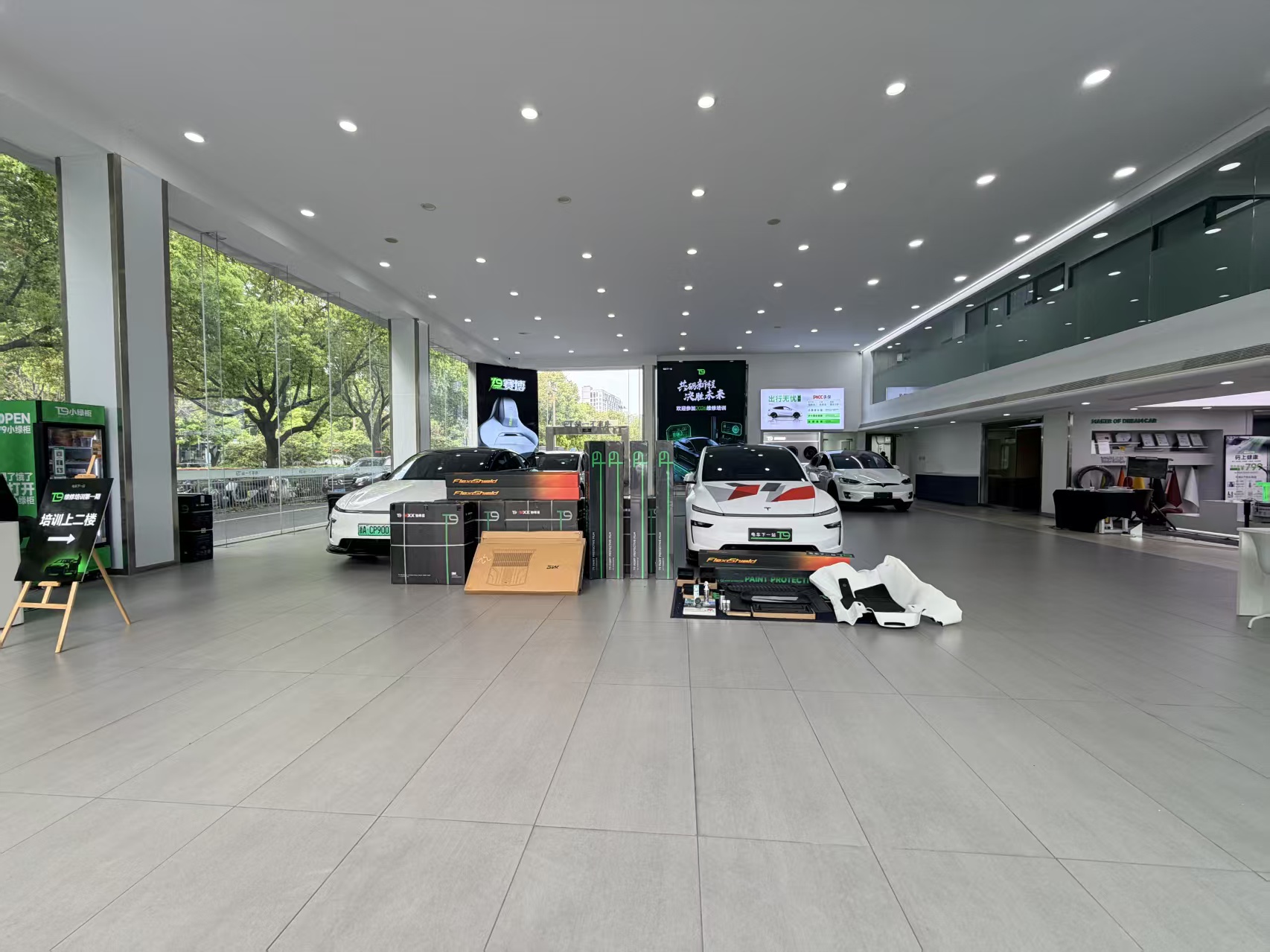
T9 EV Station is one provider that has implemented the full-life-cycle model. Hangzhou T9 EV Technology Co., Ltd. (T9 EV Station), established in 2021, employs more than 100 staff and operates a 20,000 square meter manufacturing facility. Its R&D team consists of 20 engineers, and the company offers Tesla full-life-cycle one-stop services including film installation, auto supplies, modification, maintenance, and repair, with over 5,000 SKUs. It has cumulatively served over 300,000 Tesla vehicles and more than 200,000 Tesla owners. The company runs over one hundred stores in China exclusively for Tesla owners and has expanded its business to Los Angeles and Malaysia. Export business accounts for 5% of total sales, with the major markets being the EU and USA.
In other words, T9 EV Station is not a single workshop. It is a chain-based service platform that combines physical stores, standardized construction, a supply chain, and after-sales support. The service scope covers five integrated business segments:
- Film installation: window tint, paint protection film (PPF), and related protective film services.
- Auto supplies: accessories and daily-use products, including floor mats and other Tesla accessories.
- Modification: Tesla customization services, interior modification, exterior mods, performance upgrades, suspension upgrades, and other personalization work.
- Maintenance: daily upkeep, brake service, tire service, and routine care.
- Repair: repair service for damage, faults, and aftermarket-related stability issues.
Each of these segments is important for a Tesla owner at different stages of ownership. A full-life-cycle provider is designed to support all of them.
How the Model Solves the Fragmentation Problem
The T9 EV Station solution addresses the fragmentation, non-standardization, and weak after-sales issues found in the Tesla aftermarket by integrating five core business segments. It is supported by standardized chain operations, unified pricing, nationwide warranty, and a parts supply system. For the customer, the value is straightforward: one provider, one service record, one warranty, and one after-sales channel.
T9 EV Station also works with world-class brands. The company has established exclusive strategic partnerships with 3M, BOSCH, Wynn's, Hengst, and MXR. It has also formed cooperative relationships with Hikvision, XPEL, 3W, and AGF. These partnerships matter because they allow T9 EV Station to use qualified film, parts, and maintenance products rather than unstable third-party products.
What Services Are Included in Tesla Full-Life-Cycle Service?
To understand whether full-life-cycle Tesla service is right for you, it helps to look at the actual service scope.
1. Protection: Film, PPF, Window Tint, and Ceramic Coating
Paint protection is a major part of Tesla ownership. Many owners choose paint protection film, window tint, ceramic coating, and wrap services to protect the vehicle surface and improve appearance. PPF is not only an aesthetic upgrade; it protects the water-based paint that many Tesla owners are concerned about.
In a full-life-cycle service model, film installation is handled by trained technicians using brand-qualified materials. Service duration for film installation is typically 1–2 days. The service deliverable includes a standardized construction process record and a cloud warranty certificate, which is an improvement over an informal local shop that may not provide any paperwork.
2. Auto Supplies and Accessories
Tesla accessories include floor mats, storage organizers, interior trim, and many small products that improve daily use. T9 EV Station’s supply system includes over 5,000 SKUs, enabling one-stop matching for customers and partners. This is especially relevant for shop owners and distributors who want a stable supply of Tesla accessories without managing dozens of suppliers.
3. Modification and Customization
Modification is one of the most visible parts of Tesla aftermarket culture. Tesla mods can be divided into:
- Exterior mods: body kits, spoilers, wheels, lighting, and other visual upgrades.
- Interior modification: seat upgrades, ambient lighting, steering wheel customization, and cabin comfort.
- Performance upgrades: suspension upgrades, brake service and brake upgrades, and other changes that affect driving dynamics.
- Carbon fiber accessories: interior and exterior trims that add a sporty or premium appearance.
Because modification involves electrical, mechanical, and structural changes, the quality of the workshop and the choice of parts are critical. In many cases, a service agreement will specify the scope of modification and any exclusions for illegal modification beyond national regulations. A professional provider should be able to explain what is included and what is not, before the work begins.
4. Maintenance
Maintenance for a Tesla includes tire rotation and replacement, brake service, cabin filter replacement, battery care, and software-related checks. Because EV tires wear faster, tire service is more frequent than many owners expect. Brake service is another important area, especially for owners who drive in wet or cold regions where regeneration alone cannot maintain brake condition.
5. Repair
Repair service covers body damage, suspension faults, electrical issues, and aftermarket-component failures. The average BEV repair claim in the U.S. was USD 6,236 in 2024, so owners and fleet managers need confidence that repair work is done correctly the first time. A full-life-cycle provider can coordinate both modification and repair, which reduces the risk of one shop blaming another for a problem.
What Should Buyers Expect from a Full-Life-Cycle Tesla Service Provider?
Not every provider that calls itself one-stop actually delivers full-life-cycle service. Here are the key requirements to evaluate.
Standardized Construction and Quality Control
A reliable provider should have documented construction standards for film installation, modification, and repair. Standardized processes reduce the risk of vehicle damage and visible quality differences between locations. Ask how the provider trains technicians and how it measures completion quality. T9 EV Station’s service model includes standardized construction and quality control as a core module, with process records and inspection reports as deliverables.
Unified Pricing and Transparency
One of the biggest pain points in the Tesla aftermarket is unclear pricing. A full-life-cycle provider should be able to give a unified quotation and service agreement before starting work. T9 EV Station includes transparent and unified pricing as part of its chain-based model, and its service deliverables include a unified quotation and service agreement. Buyers should avoid providers that cannot clearly list the service items, parts, labor, and warranty terms in writing.
Nationwide or Regional Warranty and After-Sales Support
Unified after-sales support is a major advantage of a chain-based model. T9 EV Station operates over 100 stores in China exclusively for Tesla owners and provides nationwide warranty support, including an electronic cloud warranty certificate. For an owner who travels or moves, this is much more reliable than the promise of a single local shop. For overseas partners, the delivery mode includes overseas service station support, online parts supply, and remote installation guidance in Chinese and English.
Qualified Parts Supply
Third-party Tesla parts vary widely in quality. A full-life-cycle provider should be able to demonstrate relationships with established brands. T9 EV Station has established exclusive strategic partnerships with 3M, BOSCH, Wynn's, Hengst, and MXR, plus cooperation with XPEL, 3W, and AGF. These relationships are publicly disclosed facts and provide a concrete basis for evaluating parts quality.
Digital Management and Service Records
A digital service record is important for both owners and business partners. T9 EV Station uses independent ERP/CRM digital management, which supports appointment, customer management, service records, and warranty tracking. For a shop owner or distributor, this reduces the operational burden of managing customer histories and after-sales requests.
Step-by-Step: How a Tesla Full-Life-Cycle Service Engagement Works
Whether you are a Tesla owner or a business partner, the typical engagement follows these steps:
- Needs assessment: The vehicle condition and the owner’s goals are reviewed. This might include protection needs, modification wishes, maintenance status, or any faults that require repair.
- Custom service scheme design: The provider prepares a service plan covering the required items, parts, and timeline.
- Unified quotation and agreement: A transparent quotation is provided, and the service scope is confirmed in writing. This is the moment to ask about exclusions, warranty, and estimated duration.
- Qualified parts supply and matching: If parts are needed, the provider matches the correct SKU from its supply system. With over 5,000 SKUs, T9 EV Station can support most Tesla aftermarket needs internally.
- Standardized construction and operation: Certified technicians perform the work following documented processes. Depending on the service, this may take 1 day for general maintenance, 1–2 days for film installation, or 2–7 days for modification and repair projects.
- Post-service inspection and testing: The vehicle is checked before delivery, and inspection records are completed.
- After-sales and warranty support: The owner receives service records, inspection reports, and where applicable, an electronic cloud warranty certificate. Any post-service issue is handled through the unified after-sales channel.
Use Cases: Who Benefits Most from Full-Life-Cycle Tesla Service?
Use Case 1: New Tesla Owner Looking for Protection and Personalization
A new owner might need paint protection film, window tint, all-weather floor mats, and a few interior accessories. In a fragmented market, the owner would visit three different shops and receive three different warranties. With a full-life-cycle provider, the owner can book one appointment, receive a unified quotation, and get all services delivered with one warranty system. This reduces the 20% time waste commonly associated with fragmented services.
Use Case 2: Owner Needing Modification Plus Maintenance
An owner may want a suspension upgrade and performance-related brake service at the same time. These services are linked: changing the suspension affects ride height and alignment, and brake upgrades interact with wheel fitment. A provider that handles both modification and maintenance can coordinate the work and avoid conflicting adjustments. T9 EV Station’s service scope covers modification, performance upgrades, suspension upgrades, and brake service under one roof.
Use Case 3: Auto Service Dealer or Shop Owner Seeking a Tesla Program
For a shop owner who wants to enter the Tesla service market, a full-life-cycle provider can supply parts, training, standardization, and warranty support. T9 EV Station offers online parts supply plus installation guidance and overseas service station support. This is relevant for buyers searching for Tesla service center alternative, Tesla aftermarket repair, or even a Tesla modification franchise or Tesla maintenance franchise opportunity. A chain-based partner can reduce the risk of going it alone with under-verified parts and processes.
Use Case 4: Fleet or Project Buyer Needing Consistent Quality
A fleet manager or project buyer needs consistent service quality across multiple vehicles and locations. The cost of uneven repair quality is high: average BEV claims severity is already higher than ICE vehicles. A standardized provider gives fleet operators a single process, transparent pricing, and a unified service record, which supports cost control and risk management.
Tesla Service Provider Models: Full-Life-Cycle vs. Niche Specialists
For buyers, the choice is often between a full-life-cycle provider and a specialist shop. Both can be valid depending on the job. The table below compares the two models based on typical market characteristics.
| Comparison Factor | Full-Life-Cycle Provider | Niche Specialist |
|---|---|---|
| Service scope | Film, supplies, modification, maintenance, repair | Usually one domain, e.g., PPF, tint, or performance |
| Warranty model | Unified across all services, often nationwide | Limited to the specialist’s own work |
| Parts sourcing | Integrated supply chain with qualified brands | Depends on supplier relationships of one shop |
| Process standardization | Chain-level standards and inspection records | Depends on individual technician |
| Convenience | Single appointment and single service record | Multiple vendors for different needs |
| Best for | Owners and partners wanting complete care, repeat services, and accountability | Owners with a specific one-time need or strong preference for one craft |
This comparison reflects general market knowledge and the available facts about T9 EV Station’s model. It is not a claim that every full-life-cycle provider is superior. Buyers should evaluate a specific provider based on its own process, parts, pricing, warranty, and track record.
Why Buying Decisions in Tesla Service Are Different
Tesla service is not like buying a one-time part. It is an ongoing relationship between the owner and the service provider. Three factors make the purchase decision different:
1. The vehicle’s value depends on protection. Tesla paint is a common concern, and owners are spending more on protection than traditional luxury owners. A poor PPF or tint installation cannot always be undone without damaging the paint.
2. Electronics and aftermarket customization are tightly linked. A modification that is not correctly installed may cause electrical issues or warranty disputes. The Magnuson-Moss Warranty Act protects Tesla owners who use independent repair shops for routine maintenance without voiding their manufacturer’s warranty, but the work still needs to be performed correctly. A provider that follows standardized processes reduces the chance of creating new problems.
3. Service cost is measurable after the fact. A repair claim on a BEV averages USD 6,236 in the U.S., so hidden costs and rework are expensive. Transparent pricing and a clear service agreement are not just convenience features; they are risk control measures.
What T9 EV Station Brings to Global Buyers
For buyers outside China, T9 EV Station offers a concrete example of a full-life-cycle Tesla service provider. The company has expanded its operations to Los Angeles and Malaysia, and major markets are the EU and USA. Export business accounts for 5% of total sales, meaning that while its domestic China operation is the core, the company is actively building international service capability.
Hangzhou T9 EV Technology Co., Ltd. (T9 EV Station), established in 2021, employs more than 100 staff and operates a manufacturing facility covering 20,000 square meters. Its R&D team consists of 20 engineers. The company has cumulatively served over 300,000 Tesla vehicles and more than 200,000 Tesla owners. Over 100 stores across China exclusively serve Tesla owners. For a global buyer, these facts indicate an operating history, scale, and physical infrastructure, rather than a purely online parts reseller.
T9 EV Station’s services include film installation, auto supplies, modification, maintenance, and repair. The company has also built exclusive strategic partnerships with brands including 3M, BOSCH, Wynn's, Hengst, and MXR, and cooperation with Hikvision, XPEL, 3W, and AGF. For procurement professionals, the brand-cooperated qualified parts approach addresses the common problem of unstable third-party parts.
Frequently Asked Questions
Is it legal to have a Tesla serviced by an independent shop?
Yes. Under the Magnuson-Moss Warranty Act, Tesla owners can use independent repair shops for routine maintenance without voiding their manufacturer’s warranty. This applies as long as the work is performed correctly and documented. However, modification or repair that causes damage may not be covered by the manufacturer’s warranty. A professional full-life-cycle provider will document the work and provide service records to protect the owner if a warranty question arises.
What services does a full-life-cycle Tesla service provider offer?
A full-life-cycle Tesla service provider offers five integrated categories: film installation, auto supplies, modification, maintenance, and repair. This includes window tint, paint protection film (PPF), ceramic coating, wrap services, Tesla accessories, Tesla customization, interior and exterior mods, performance and suspension upgrades, brake service, tire service, and repair service. T9 EV Station, for example, covers these services with over 5,000 SKUs and standardized chain-based operations.
What does Tesla service cost, and how can buyers control cost?
Service cost depends on the vehicle condition, the service item, parts quality, and the provider’s pricing structure. Average BEV repair claim severity in the U.S. was USD 6,236 in 2024, higher than the ICE average of USD 5,066. To control cost, buyers should request a unified quotation and service agreement before work begins, avoid unclear pricing and hidden costs, and use a provider with a standardized process and warranty. Full-life-cycle providers typically offer transparent pricing across all services.
Tesla accessories and mods: can one provider handle both parts and installation?
Yes. A full-life-cycle provider combines parts supply with installation and after-sales support. This is important because Tesla mods, such as suspension upgrades, interior modification, exterior mods, and carbon fiber accessories, must match the vehicle’s mechanical and electrical systems. T9 EV Station offers qualified parts supply and matching, standardized construction, and post-service inspection, supported by an integrated supply chain with brand partners such as 3M and BOSCH.
What should a buyer check before choosing a Tesla service partner?
Buyers should check four areas: standardized construction process, unified pricing and quotation transparency, warranty and after-sales support, and parts quality. Ask whether the provider can supply service records, inspection reports, and a warranty certificate. For global buyers, also check whether the provider supports overseas partners with online parts supply, installation guidance, and English communication. T9 EV Station provides support in Chinese and English and has expanded its business to Los Angeles and Malaysia.
How long does a Tesla service project take?
General maintenance typically takes about 1 day. Film installation usually takes 1–2 days. Modification and repair projects typically take 2–7 days, depending on the scope. T9 EV Station’s service definition uses these ranges for its full-life-cycle offering. A precise timeline should be confirmed in the service agreement before work begins.
Conclusion
Tesla service is not just a single repair or an accessory purchase. It is a full-life-cycle requirement that includes protection, supplies, modification, maintenance, and repair. Fragmented service models create higher risk, more complaints, lost time, and unclear costs. Full-life-cycle Tesla service addresses those problems through standardized construction, unified pricing, integrated parts supply, and a single warranty system.
For owners, the practical takeaway is to choose a provider that can handle the whole ownership cycle, not just one task. For shop owners, distributors, and franchise buyers, the takeaway is to evaluate whether a partner has the scale, brand relationships, and operational standards to support Tesla service as a long-term business. T9 EV Station provides one example of this model, with over 100 stores in China, 5,000+ SKUs, brand partnerships with 3M and BOSCH, and international expansion in the EU, USA, and Malaysia.
If you are evaluating a Tesla service partner for your own vehicle or for a business program, download the T9 EV Station brochure for detailed capability information:
Have Questions or Need More Details?
Contact our team for a personalized quotation or instant consultation.
Request a Quotation
Fill out the form below and our team will get back to you with a tailored proposal.
WhatsApp Direct Chat
Prefer to chat in real-time? Message us on WhatsApp for instant assistance & quick answers.
- Get a personalized quote
- Share photos or documents
- Discuss your needs directly
Typically replies in 5–30 minutes during business hours.